Location· CityMETER · Thailand
A factory inventory is a starting point for an industrial-area enquiry
Factories, Workers & InvestmentThe April 2025 factory view displays 71,699 factory records alongside a reported workforce figure of 3,923,728. Reading establishments and reported personnel as separate measures provides a starting point for studying industrial groups and the service questions around a chosen area.
A view inside CityMETER
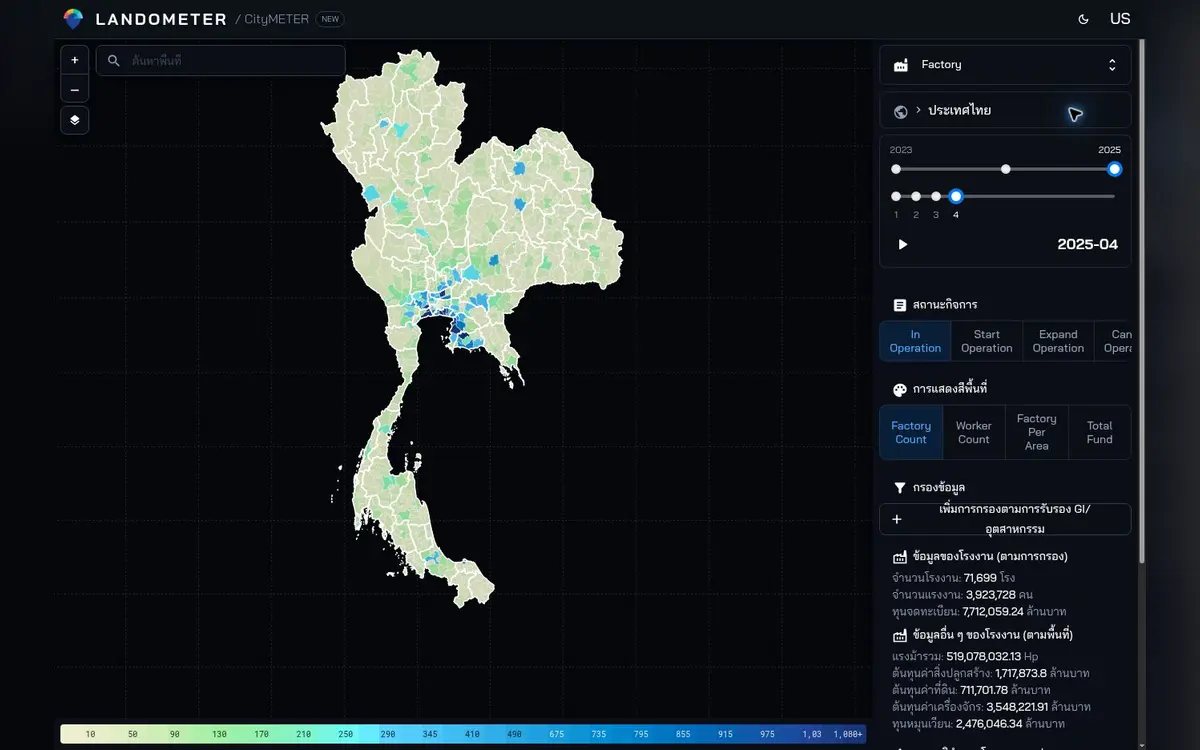
Thailand · April 2025 · inspected on 10 October 2026 · factory records and reported workforce figures in the displayed database.
- Data period
- April 2025 (map data period)
- Coverage
- Source records organised by province
- Level of detail
- Factory records · reported workforce and capital
- Publisher
- Office of the Permanent Secretary, Ministry of Industry
Choose the industrial question first
Work in an industrial area can begin with a partner search, a site study or a need to understand the activities represented nearby. Selecting the relevant industrial group and status turns a large database into a more manageable enquiry. The next task is to identify which records connect with the target area and what should be followed up at factory level: the entity name, location and measure being discussed. This gives the work a purpose before attention shifts to the size of the totals or the appearance of the map.
Keep establishments and people on separate lines
Factory counts describe a set of establishments. Workforce figures belong to another measure, read with its reference period and definition. Keeping them on separate lines lets a team distinguish a question about the network of places from one about personnel information needing follow-up. If the work is taken into a discussion about local services, name the measure being used. The people involved can then respond to a specific reference, and new information can be added to the appropriate part of the enquiry rather than merged into an ambiguous industrial total.
Use additional measures to deepen a specific enquiry
Capital or machinery measures available in the view can help define a further line of research once the relevant factory group has been identified. Choose the measure that fits the question and retain its unit. The team can then ask for the appropriate kind of information from the people concerned. A narrower enquiry directs effort towards relevant details instead of placing every available figure into a presentation without a clear job. Each measure should help explain why a record needs attention and what information would advance the investigation.
Give the field team a shared agenda
Before a visit, choose a small set of factories and state what the team wants to understand. Keep name, position, reference period and question together. When a document or contact supplies an answer, add its source and date distinctly. The 71,699-record inventory becomes the beginning of work that can be followed and revisited. At the next discussion, colleagues can identify what has been learned about the selected activities and places, which assumptions changed and which remaining question deserves attention. The map gives that conversation a concrete set of references.
Explore your own place
Choose the relevant industry and area, then retain a short list of factory names, reference periods and measures to follow up.
Sources and reading notesPublisher, period, coverage and references
Related reference — exact data release not confirmed
- Data publisher
- Office of the Permanent Secretary, Ministry of Industry; records supplied by operators or provincial industry offices
- Source
- Factory-location records are published through the ministry’s catalog and indexed by GD Catalog. Match the records and measure definitions to the map’s release before combining them.
- Data period
- The map identifies April 2025. Source metadata lists a data update on 8 July 2025 and GD Catalog registration on 4 August 2025; these are separate dates.
- Coverage
- The source is organised by Thai province; coverage of the displayed factories depends on the data release and selected area.
- Level of detail
- Factory records with reported status, workforce, capital or machinery measures
Further notes for comparison or citation
Registry figures need their definitions and operating status confirmed before being used as current production capacity or employment.
Check operating status, workforce definitions, capital and machinery units, and reference dates before treating registry figures as current employment or production capacity. Catalog registration is not the factories’ data vintage.
Compare factory types, status, units and periods when reading locations and reported figures, then select areas or factories for further research.