Location· CityMETER · Thailand
What 16,488 7-Eleven records reveal about a retail inventory
Retail & Wholesale NetworksThe retail inventory contains 27,608 stores across 17 brands, including 16,488 7-Eleven records. That concentration makes one network prominent in the recorded set. The more local question is how different store types and brands sit together in the areas people use.
A view inside CityMETER
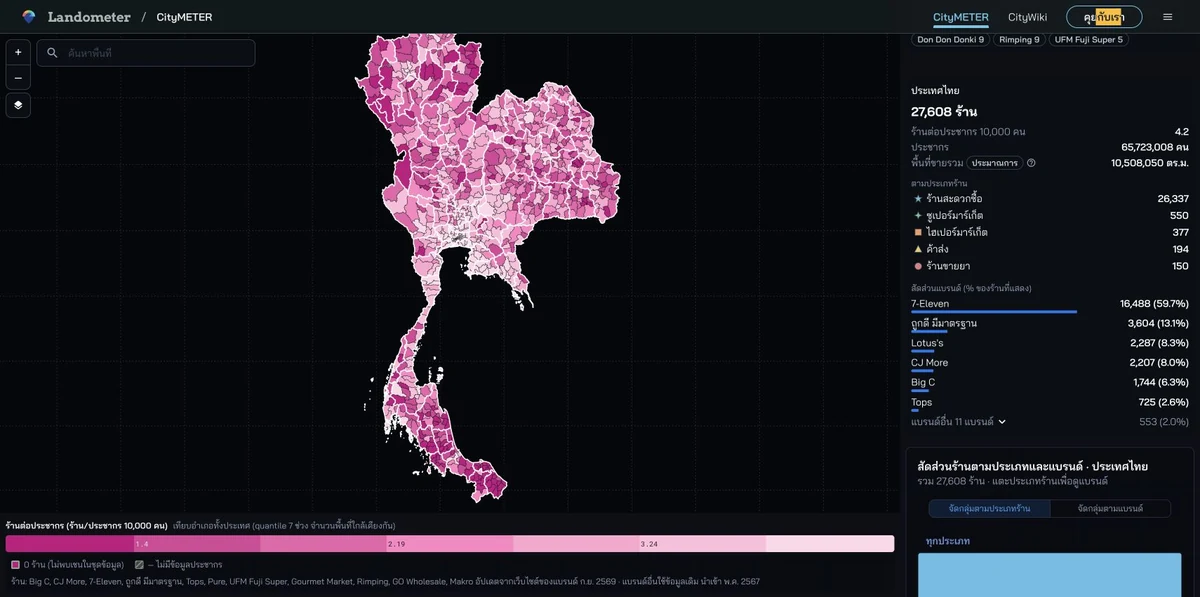
Thailand · inventory inspected on 10 October 2026 · recorded stores and brands · the population-based density view uses stores per 10,000 people.
- Data period
- Selected locators checked Sep 2026 · legacy import May 2024
- Coverage
- Selected retail, wholesale and pharmacy chains
- Level of detail
- Stores · brands · floor area estimated by store type
- Publisher
- Brand store locators · legacy CityMETER inventory
A retail landscape is made of different kinds of store
Convenience stores, supermarkets, wholesalers and pharmacies occupy different roles in a retail landscape. Separating store types helps a marketing team choose a comparison relevant to the intended service. Start with the kind of outlet connected to the product, then examine the brands recorded in the area. National counts establish the scale of the inventory. The actionable enquiry takes place within the geography under consideration and the type of shopping being studied. That distinction keeps a broad network view connected to the purpose of a particular market visit.
A different denominator asks a different question
A store count asks how many records appear in an area. Stores per 10,000 people place that count against a population denominator. With consistent population references and boundaries, a team can compare the density of recorded networks in that specific sense, then decide where to investigate. Keep both measures in the working note. The reader should be able to see whether the conversation concerns the size of a network or the number of stores relative to the population used in the calculation. Each supports a different question about the same place.
Give the visit a question the inventory cannot answer alone
Once a group of outlets looks relevant, arrange a short visit to examine merchandise type, entrances and immediate surroundings. The initial brand and store-type records help divide the fieldwork: one person can examine access while another records the formats encountered. Link those observations back to the selected inventory records. The visit then adds to the same investigation rather than producing a separate album of photographs. It also reveals which questions need another visit or a direct conversation, giving the team a practical way to refine its understanding of the network.
Keep the count share attached to the counted set
The 16,488 7-Eleven records have a clear meaning when read with the 27,608-store base and the selected brands. A team can use store-count shares to describe the composition of the recorded network, then take specific competitive questions into the field. If the selected type or brand set changes, retain that choice with the new result. The useful output is a network picture with an explicit counting base, a bounded geography and a plan for further research. Those details make the comparison understandable when it is shared with another team.
Explore your own place
Choose the store types and brands relevant to the market, compare counts with population-based density and select one area for a field visit.
Sources and reading notesPublisher, period, coverage and references
Specialist source
- Data publisher
- Brand store locators and the legacy CityMETER inventory
- Source
- Some brands use their store locators; other records use legacy data or manually checked coordinates. Read each store’s provenance.
- Data period
- Selected locators checked 29–30 September 2026; legacy data imported 12 May 2024 with original collection dates unknown.
- Coverage
- Selected chains covering retail, wholesale and pharmacies; not a census of every shop
- Level of detail
- Stores, brands and store types; sales-floor area is estimated by type
Further notes for comparison or citation
Shares of recorded branches are not sales shares. Selling areas are estimates, and not every shop is included.
Store counts and count shares are not sales, revenue share or observed demand. Verify operating status and floor area before planning.
Captured on 10 October 2026. Values and available controls may change in the live service.