Location· CityMETER · Thailand
Count the rooms as well as the hotels
Hotel Supply, Rates & SeasonalityThe hotel inventory displays 28,380 properties and 839,763 rooms. Reading both counts gives an accommodation study two views of recorded supply: the number of places and the number of rooms behind them. The next enquiry can then focus on a particular area, price range and season.
A view inside CityMETER
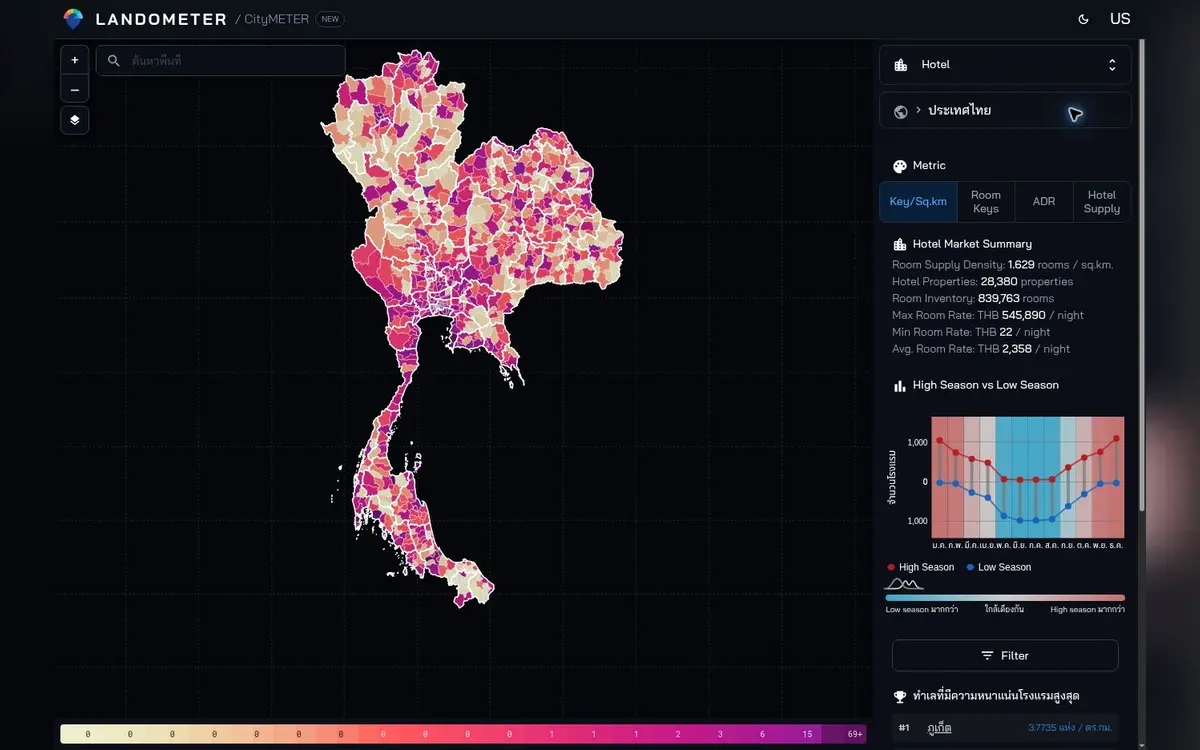
Thailand view inspected on 10 October 2026 · recorded properties and rooms · displayed mean advertised rate: THB 2,358 per night.
- Data period
- Read the details in sources
- Coverage
- TAT accommodation · Bangkok hotel-association members
- Level of detail
- Properties · recorded rooms · advertised rates
- Publisher
- TAT · BMA Digital Strategy Division
A property count does not describe every property’s scale
A person studying an accommodation location needs to decide whether the comparison concerns providers or rooms. Keeping those units distinct makes the enquiry clearer. Two areas with similar property counts could have different compositions of property size; the investigation is to examine the available records rather than assume the relationship. Begin with the group connected to the target market and identify which properties need closer research. The national figures give scale, while the local records allow a team to define the specific supply question it wants to answer.
Use advertised rates to focus the next conversation
The displayed mean advertised rate of 2,358 baht per night adds another dimension to the enquiry. Read it with property type and location to prepare questions about the room and stay period being studied. When checking offers for selected properties, use comparable stay conditions so the answers can be understood together. This lets the team identify whether a difference concerns room type, date or an offer condition. The price layer helps organise the research; property-specific responses then give the comparison the detail required for a useful discussion.
Give seasonality an explicit period
Seasonality becomes useful when everyone knows the period under discussion. If the assignment concerns a market plan, choose the month or stay window and keep it beside the prices or counts being examined. A shared time frame also helps organise contact and fieldwork around the same question, such as comparing offers for one period across several properties. This small piece of context makes the work easier to revisit. Later information can be added to the appropriate period instead of being mixed into a general impression of what the market is usually like.
Take the supply picture into a bounded study
Choose one area connected to the assignment and read properties, rooms and advertised rates as separate dimensions of the same study. Select places to contact with a reason for each, such as a relevant format or price band. Keep later answers with their dates and conditions. A national inventory allows the research to begin broadly, but it is the bounded list and checked local information that make the enquiry practical. The result should show what is being studied, why these places were chosen and which questions the team will pursue next.
Explore your own place
Choose one area and stay period, examine room supply alongside advertised rates, then contact properties relevant to the target market.
Sources and reading notesPublisher, period, coverage and references
Related reference — exact data release not confirmed
- Data publisher
- Tourism Authority of Thailand; Bangkok Metropolitan Administration — hotel dataset published by its Digital Strategy Division
- Source
- TAT publishes accommodation types and locations from its tourism marketing database. BMA records include hotel names, districts, coordinates, rooms and grades. Neither reference establishes the source of the map’s price or seasonality measures.
- Data period
- TAT metadata lists 11 June 2026; the BMA hotel resource lists 23 June 2023. These dates do not establish the period of the map’s displayed inventory or rates.
- Coverage
- TAT covers multiple accommodation types across Thailand. The BMA source covers Bangkok hotels registered with the Thai Hotels Association, not every hotel.
- Level of detail
- Properties, recorded room counts and advertised rates
Further notes for comparison or citation
Listed prices and room counts do not establish occupancy, bookings or hotel revenue.
Sources differ in accommodation types, coverage and dates. Registered room counts do not measure availability or bookings. The displayed rates and seasonality still need their source and method matched; they cannot establish occupancy or revenue.
Start with accommodation types, locations and recorded rooms. Check price collection dates, room conditions and stay dates before choosing market comparisons.