Location· CityMETER · Thailand
Meeting an area through its places of worship
Places of WorshipThe inventory contains 51,901 places of worship: 50,439 active records and 1,462 abandoned-temple records. Keeping those statuses visible gives a map more than one line of enquiry, from present service locations to places that call for historical and community context.
A view inside CityMETER
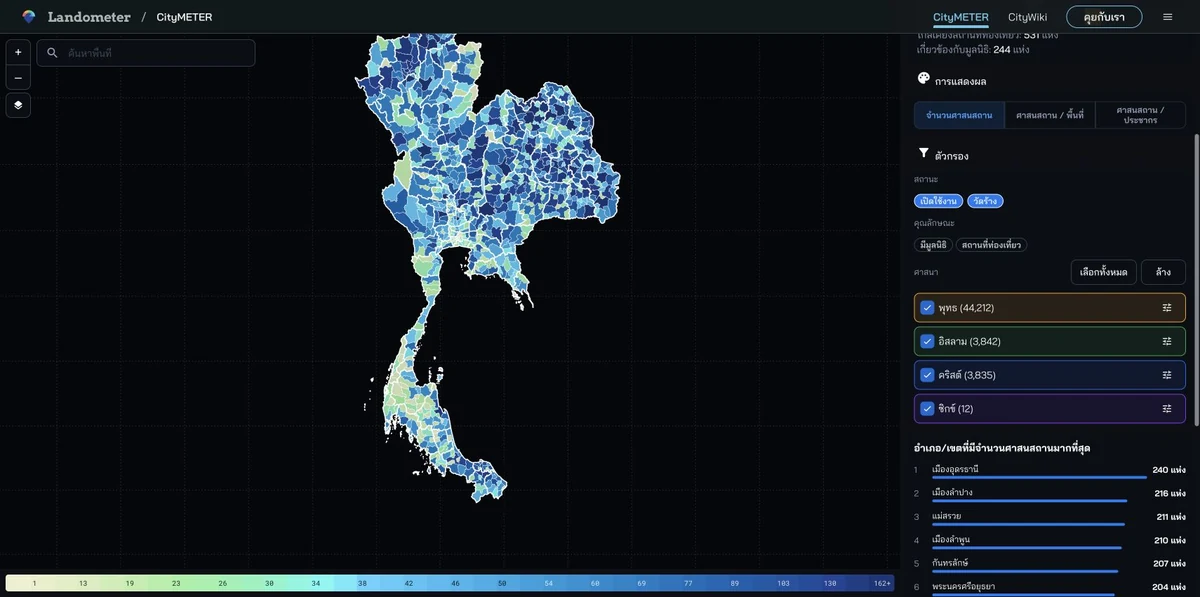
Thailand · inspected on 10 October 2026 · publishable Buddhist, Muslim, Christian and Sikh records · place status is retained.
- Data period
- Reference date of each record
- Coverage
- Publishable Buddhist, Muslim, Christian and Sikh records
- Level of detail
- Places · mapped records and coordinate quality
- Publisher
- Read the details in sources
A named place is a useful beginning
Someone preparing to work with a community needs a place to begin learning. A named worship site can provide a concrete reference for research and contact. Reading its type and status gives the record more context than a point alone. The person preparing the work can then frame questions appropriate to the place and seek knowledge from those connected with it. This is a modest but useful role for the map: it helps organise an introduction to an area through identifiable locations, with room for local people to explain their own context.
Status changes the kind of enquiry
An active-site record and an abandoned-temple record can lead to different enquiries. One may prompt contact about the place’s present role; the other may invite historical research or a search for the people responsible for local information. Keeping status separate helps a team prepare more appropriate questions and visits. Retain the name and reference used for each record so later answers can be linked back to the same place. The inventory then becomes a starting framework for learning, capable of accommodating information that comes from conversations as well as documents.
Let local knowledge give the map meaning
The map identifies places in the inventory; questions about role, activities and contact arrangements belong in a conversation with the people concerned. Preparing a short set of questions makes that conversation clearer and respects the time of those helping. Record which information was provided, when it was provided and who should be contacted next. This turns a mapped list into a process of learning from people connected with the place. The work gains depth through those conversations while retaining the original location that brought the enquiry there.
Move from the national set to one local relationship
The 51,901-record inventory is large, but one useful enquiry may begin in a very small area. Choose a place relevant to the assignment, check its position and contact route, and prepare questions that allow local people to explain the context in their own terms. The outcome to seek is an attributed understanding and a sensible next contact. In this way the map opens a route into conversation. The meaning of the place develops through learning and follow-up, with the record serving as a reference that can be shared and revisited.
Explore your own place
Choose one area, check the place names and statuses, and prepare questions for learning from the people connected with them.
Sources and reading notesPublisher, period, coverage and references
Source details still need confirmation
- Data publisher
- Original publishers are not yet fully verified for each record
- Source
- Source and reference date belong to each record; check them before combining religions or totals.
- Data period
- Reference dates vary by record; no single date represents the entire inventory.
- Coverage
- Publishable Buddhist, Muslim, Christian and Sikh records, including active places and abandoned temples
- Level of detail
- Distinguish total records, mapped records and coordinate quality
Further notes for comparison or citation
No map pin does not mean no place of worship. Population-per-site ratios are not follower counts or venue capacity.
A missing point does not mean no place exists. Population per site is not capacity, attendance or religious affiliation.
Captured on 10 October 2026. Values and available controls may change in the live service.