Living· CityMETER · Thailand · the displayed school inventory
A school map becomes more useful when you read beyond the pin
Schools, Students & TeachersFor a team working on education services, a school pin is the beginning of a larger enquiry. CityMETER’s Thailand view displays 65,725 school records alongside students, teachers and classrooms. Reading these dimensions together helps identify places and institutions worth getting to know more closely.
A view inside CityMETER
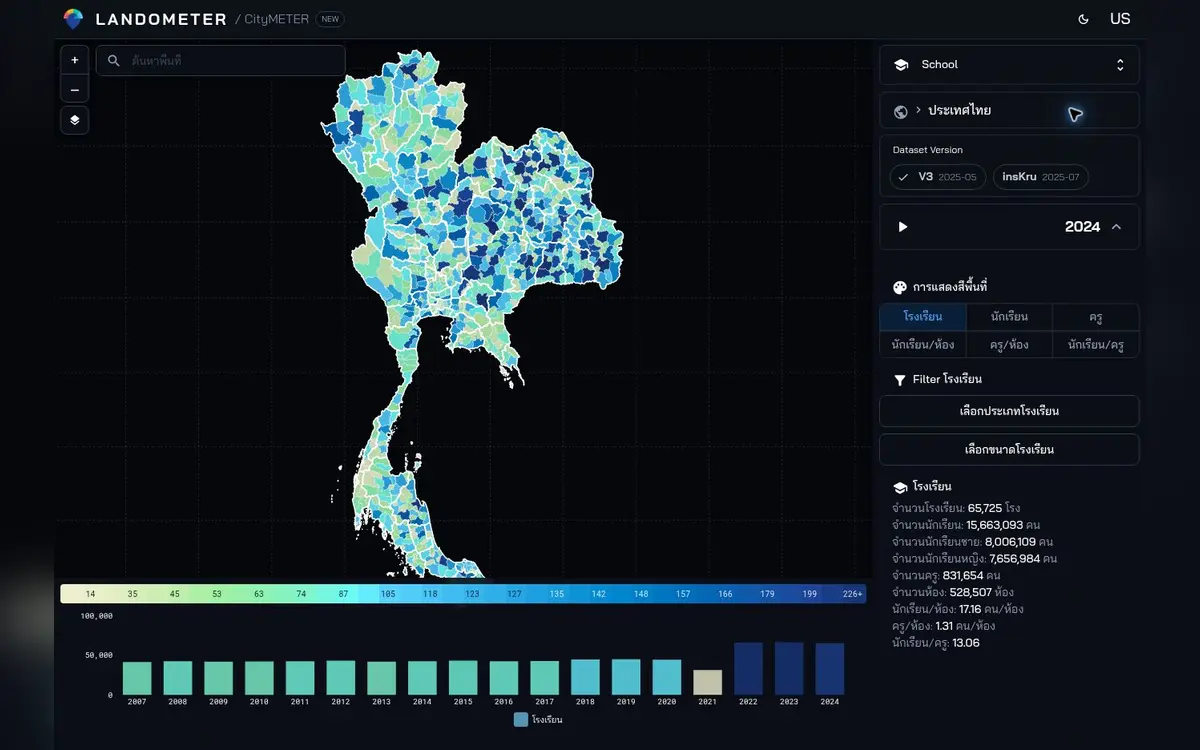
Thailand view inspected on 10 October 2026 · 15,663,093 students, 831,654 teachers and 528,507 classrooms displayed · version options include V3 May 2025, insKru July 2025 and 2024.
- Data period
- Read the details in sources
- Coverage
- Read the details in sources
- Level of detail
- Schools · students, teachers and rooms by data version
- Publisher
- Read the details in sources
Choose the education question before comparing schools
A team considering early childhood services has a different starting question from one working with older students. Choosing the relevant education level and school type makes the study group more meaningful. Select an area, look at the distribution of comparable records and identify institutions to contact for a specific reason. A school might offer the level relevant to the project or sit within a service area being reviewed. The point is to make that reason explicit. Colleagues can then discuss the same group of institutions and spend their time gathering details that relate directly to the assignment, instead of assembling an undifferentiated list of every school nearby.
Students, teachers and rooms describe different parts of provision
Student, teacher and classroom figures bring different aspects of provision into view. For a learning-support project, examine the dimensions relevant to the selected institutions and record the data year alongside them. Prepare questions about class organisation, the staff involved and the rooms used for activities. Having several dimensions in the same study helps a team organise one coherent conversation rather than ask for each number in isolation. School staff can explain the context of the figures and how activities are arranged. The useful output is a clearer picture of what the team wants to learn about an institution and who is best placed to explain it.
Bring the school location into a local journey study
Once the relevant schools are located, the next study might examine journeys linking homes, pick-up points and schools. Define the time period and user group, then take those locations into a walking survey or a discussion with parents and transport providers. Keep the additional observations within the same study boundary. A shared set of locations helps education and neighbourhood teams connect their work: one may be considering an activity programme, while another examines the surroundings of the institutions involved. The school map provides a common starting point for those conversations, and the journey study supplies the local detail needed to understand how people reach the service.
Make the next school conversation easy to follow
Before contacting a school, prepare a short note with its name, location, education level, data version and the topic to discuss. Keep subsequent answers with their dates and the responsible contact so the team can follow the enquiry over time. In a meeting involving several organisations, a small selection of institutions with clear context can be more useful than a long list of unexplained totals. Each example gives the conversation a place, a service and a question. The national inventory has done its job when it helps a team arrive at those grounded conversations and organise the next stage of work around them.
Explore your own place
Select schools relevant to the assignment, then take their locations and a clear set of questions into the next conversation.
Sources and reading notesPublisher, period, coverage and references
Related reference — exact data release not confirmed
- Data publisher
- Ministry of Education (candidate)
- Source
- The data relates to Ministry of Education school records, but school codes, names and reference years still need to be matched to the displayed records.
- Data period
- Period not confirmed — check the reference date in the data view before use.
- Coverage
- A Thailand summary view is visible; source coverage is not stated
- Level of detail
- Schools, students, teachers and classrooms for the selected data version
Read the references
Further notes for comparison or citation
Record completeness varies. Teacher and classroom counts do not establish teaching quality or available places.
Student, teacher, classroom and ratio coverage may differ. Check the averaging method before comparison; these measures are not school quality or spare places.